
Reaching Donors Beyond the Airwaves: How Intent Beats Identity
Public media fundraising is at an inflection point.
In 2025, the system experienced an extraordinary surge in giving driven by federal funding cuts. That moment mattered, and so did the data it produced. After several years of decline, on-air pledge rebounded, with radio stations doubling new donor acquisition through pledge year over year. For TV and joint licensees, results were positive at the median, though less consistent across stations, as seen in the chart below.
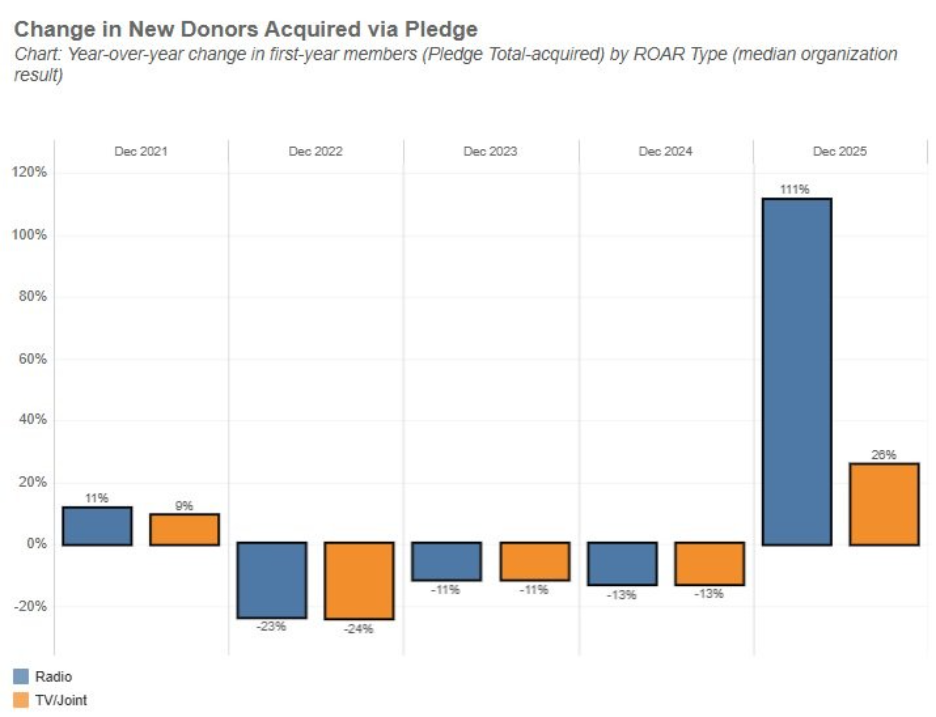
Pledge clearly still matters. But the longer-term picture tells a more complex story about how donors are entering the system, and what it will take to sustain the pipeline going forward.
Pledge Strength, Changing Realities
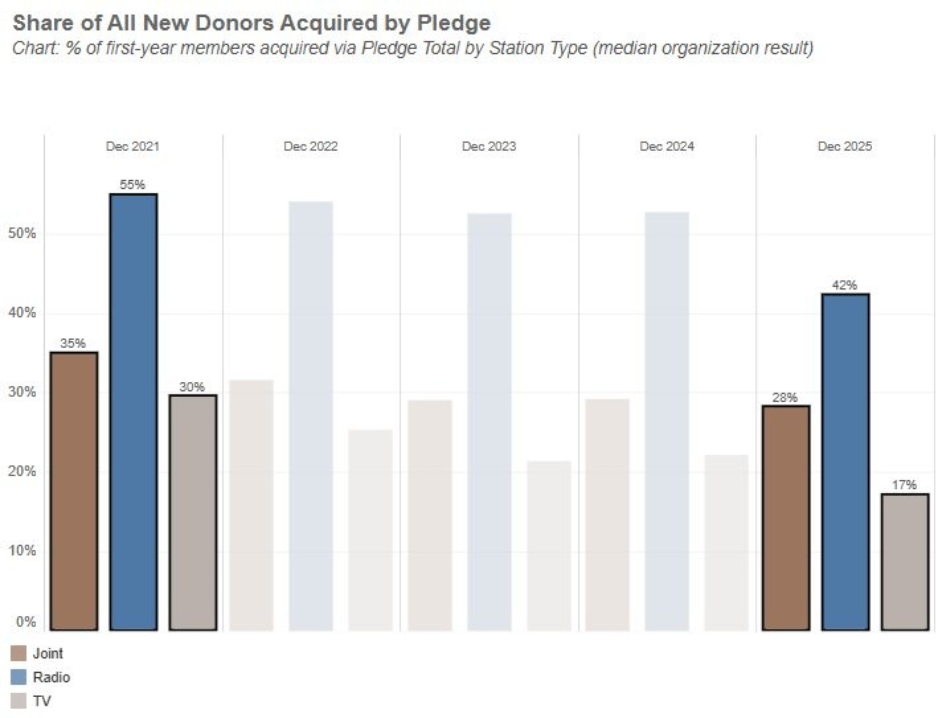
Even with the 2025 rebound, pledge as a source of new donors has been declining across radio, TV and joint licensees since 2021. For radio, 2025 marked the first time in the reporting period that fewer than half of new donors were acquired through pledge, as seen in the chart below.
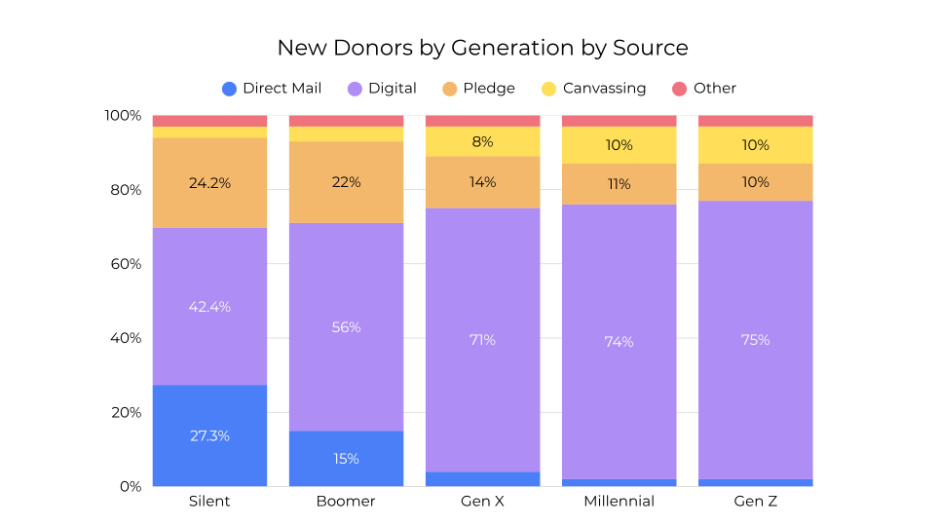
Equally important is who pledge is bringing in. Acquisition remains strongest among older donors, with significantly smaller shares coming from Gen X, millennials and Gen Z. While broadcast continues to engage core supporters, it is far less likely to serve as the entry point for younger and next‑generation donors.
This mirrors broader audience behavior. As listening and viewing continue to shift from broadcast to streaming and digital platforms, discovery and giving are shifting as well.
The takeaway isn’t that pledge no longer matters. It does. But pledge alone can no longer carry the full acquisition load.
Digital as a Primary Entry Point
When we talk about digital acquisition, we’re looking at gifts made online across a range of motivators — email, text, display advertising, paid search and other digital touchpoints (the chart below excludes web pledge and Passport forms to isolate digital as its own channel).
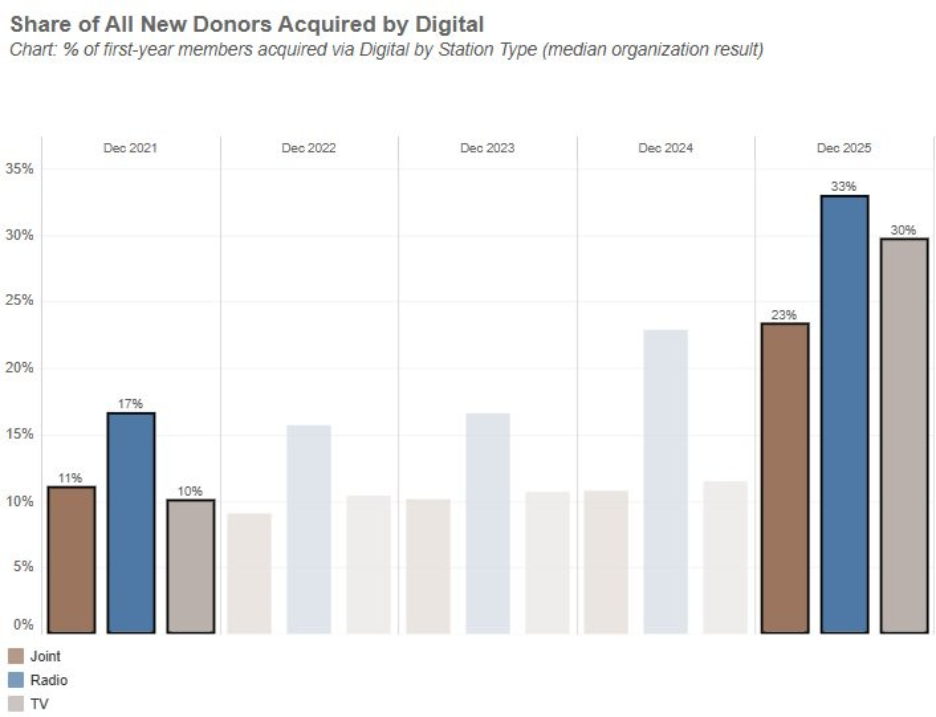
One of the clearest patterns in the data is that digital giving spikes during moments of urgency or crisis. We saw this during COVID and again more recently with the elimination of federal funding. When something happens that creates a strong emotional response, people don’t wait for pledge or mail. They give online immediately.
Digital pathways also skew younger. Donors acquired through digital channels and Passport increase sharply as generations get younger, making digital the default entry point for many Gen X, millennial and Gen Z supporters.
Over time, ongoing investment in digital ads, Passport promotion, email, and omni‑channel integration compounds. Digital doesn’t just respond to urgency — it builds familiarity and readiness, so when the moment comes, giving is easy.
Why Intent Matters
Most digital fundraising still relies on identity-based targeting — age, income, location or past giving behavior. But identity alone doesn’t explain why someone might care about public media.
That’s where intent comes in.
Inuvo is a digital display advertising program built for public media, using intent-based targeting to reach people who are actively expressing interest in values-aligned topics across the web, regardless of whether they’ve ever donated, listened or self-identified as public media supporters.
Rather than relying on last-click behavior, Inuvo’s display ads operate higher in the funnel, building awareness and influence over time. Campaigns run at scale year-round and improve as they stay live, continuously learning which audiences are most responsive and adjusting delivery accordingly.
For stations, this means reaching new and younger audiences beyond broadcast, creating familiarity before moments of urgency arise, and supporting giving across channels — not just the final click.

What the Results Show
From August 2025 through February 2026, 25 public media organizations participated in Inuvo campaigns. Together, they achieved:
42.9 million impressions delivered, providing reach most stations could not achieve on their own
$1.08 million in directly attributable donations, demonstrating measurable revenue, not just awareness
2.24x average return on investment, with several stations achieving 4x–11x ROI
These results reinforce a growing reality: digital is no longer just a supporting channel. It’s becoming a primary pathway into the donor pipeline, especially for younger audiences.
Building What Comes Next
The fundraising mix is changing. Growth outside of pledge is creating more diversity in acquisition, but it also means stations need multiple, complementary pathways to reach new donors.
Intent-based digital strategies like Inuvo don’t replace pledge. They extend it by meeting audiences where they already are, introducing public media earlier in the relationship, and converting attention into real support.
As audiences continue shifting beyond the airwaves, reaching donors there isn’t optional. It’s essential to building the future of public media.